About Leh District (Ladakh)
Historically, Leh was an important route to trade with Tibet, Kashmir and China for centuries. In the past Leh (Ladakh) was well-known by different names. It was called Maryul or low land by some Kha- chumpa and also by others. On the other hand FaHein referred to it as Kia-Chha and Hiuen Tsang as Ma-Lo-Pho. Legends believe that the Brokpas from Dadarstan were the first immigrants to this land, then they inhabited in the lower reaches of the Indus Valley at that time popularly known as Sham. Later another wave of immigrants came from karja (Kulu) were the Mons, an Aryan type who first settled in Gya and after sometime spread to Rong, Shayok, Sakti Tangtse and Durbuk. Dards, an Indo-Aryan race was also an inhabitants of Ladakh in the ancient era. Some immigrants of Tibet like Skardo and its nearby parts like Purang and Guge were too settled in Ladakh. Buddhism came to India from Tibet through Ladakh where it left its imprint very deeply. Where as Islamic missionaries also made a peaceful penetration of Islam in this region in the early 16th century. Since the mid of the 10th century Ladakh was an independent country. Finally, in the year 1979 when the reorganization of the districts was started, the district of Ladakh was divided into two full fledged district of Leh and Kargil. Thus, the district of Leh came into existence in the map of Jammu and Kashmir state on 1st July, 1979.
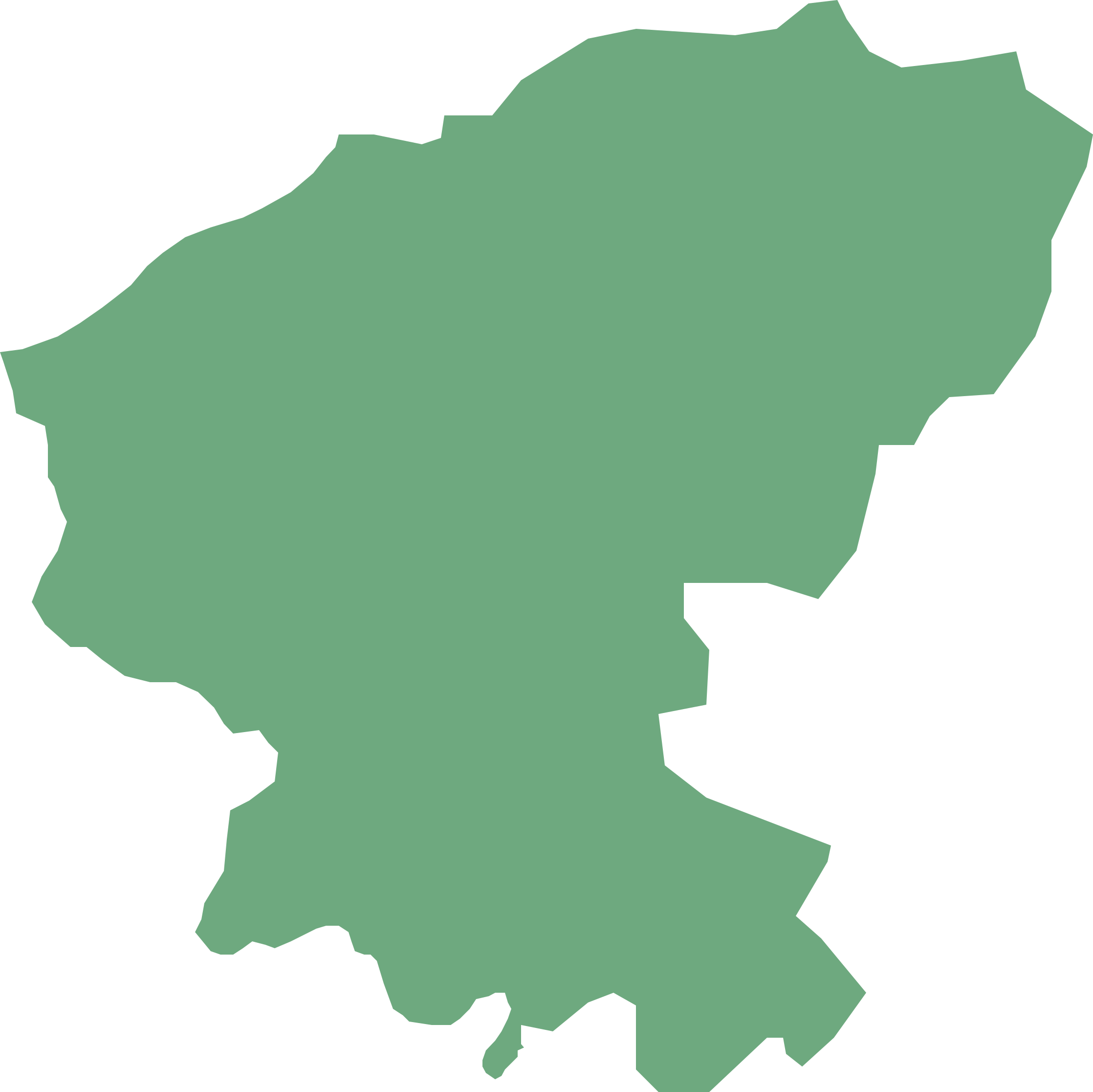
Geographically, the district has a total 45,110 sq km. area and rank 1st in State and 2nd in India on the bases of this size. In the year 2023, there was a total 1.45% forest area of total geographical area. It lies at 34°00'N latitude, 78°00'E longitude and 5753 m altitude. The district is enclosed by Pakistan occupiedKashmir in the west and china in the north and eastern part andLahul Spiti of Himachal Pardesh in the south east. It is situated at adistance of 434 km. from the State capital Srinagar. The prominent rivers that flows through the district are Shayok, Indus and Zanskar. The climate of the district remains pleasant almost throughout the year. Most of its rainfall occurs in the monsoon season.The actual rainfall in the district was 50.5 mm in the year of 2024-2025.
Administration wise, the district is divided into 3 sub-districts, 3 towns and 111 villages. Urdu is its official language. The district came into existence on 1st July, 1979 with its administrative headquarters located at Leh which is situated at the distance of 416 kms from the state capital. Leh District is under the administration of an elected body the Ladakh Autonomous Hill Development Council (LAHDC), Leh. It was established in 1995.
Demographically, according to the 2011 census, the district has a total 20,777 households with the total population of 1,33,487 comprising 78,971 are males and 54,516 are females which is leading it to the rank 22nd in the state and 609th in India. The population density of the district is 3 (persons as per sq km.). The district has a sex ratio of 690 (females as per 1000 males) and child ratio of 946 (females as per 1000 males). Furthermore, the district has projected population of 1,62,786 comprising 96,402 males and 66,384 females for the year 2026. According to the National Family Health Survey (NFHS-5, 2019–21), the district has sex ratio of 967 females and a child sex ratio of 948 females per 1,000 males. According to 2011 census, the principal language in the district is Ladakhi with 3.31%. As per 2011 census the main religions in the district are Hindu with 17.14% and Muslim with 14.28% of its total population. The population growth rate during the period 2001-2011 was 13.87% including 22.81% were males and 3.00% were females. In the year 2023 the number of live births in the district was 5,142 out of which 2,614 were males and 2,528 were females. In the same year the number of deaths in the district was 524 out of which 349 were males and 175 were females.
Economically, the district is mainly dependent on the agriculture. Tourism is the secondary source of income here. Grim (naked barley) is the main crop grown here. Indus River is the main source of water for irrigation. Salt, grain, pashm or cashmere wool, charas or cannabis resin from the Tarim Basin, indigo, silk yarn and Banaras brocade are the main items of the district. In the year 2005-2006 the Gross Domestic Product in the district was Rs. 46,687 lakh at current price and Rs. 35,660 lakh at constant 1999-2000 prices. The Net Domestic Product in the district during the period 2003-2004 was Rs. 23,081 lakh at current price and Rs. 10,583 lakh at constant 1993-1994 prices. The Per Capita Income or NDDP, At Factor Cost in the district during the period 2003-2004 was Rs. 18,465 at current price and Rs. 8,466 at constant 1993-1994 prices.
Education wise, according to the 2011 census, the literacy rate in the district is 77.2% including 86.31% are males and 63.56% are females. The number of literates in the district is 93,770 out of which 62,834 are males and 30,936 are females. In addition, according to the Periodic Labour Force Survey (PLFS) for the period July 2023-June 2024 estimated literacy rate in the district is 78.54% including 86.47% are males and 70.77% are females (Age 7 Years and Above). The district has educational institutes including schools and colleges.
The district has many famous political personalities. Thupstan Chhewang belongs to BJP. He represented the Ladakh constituency in the 14th and 16th Lok Sabha of India. He is also serving as a National Executive member.
The district has many famous historical and religious tourist places. These places are Pangong Lake, Tsomo Riri Lake, Sculpture at Drass, Lamayuru Monastery, Rock Cut Sculpture at Mulbekh, Leh Palace, Likir Monastery, Alchi Monastery, Phyang Monastery, Hemis Monastery, Stupa at T-Suru, Shey Palace, Old Castle Tsemo Hill, Leh Mosque, Basgo Castle.
The district is the birthplace of numerous famous persons from different fields. Thinlas Chorol is a social entrepreneur and writer. She is the founder of the Ladakhi Women's Travel Company. She has written several articles on tourism in Ladakh and other issues. She is a renowned woman guide in trekking. Eliezer Joldan was the first trained graduate teacher in Ladakh. There is a Govt. Degree College at Leh which is named after him. Chewang Norphel (Ice Man) is an Indian civil engineer from Ladakh. He has built 12 artificial glaciers in the place.